Showing posts with label food security. Show all posts

Friday, January 22, 2010

Alertnet: Kenyans insured for herd losses in drought via satellite images

Pastoralists would get automatic payments for losses if satellite images of the region show vegetation fades from green -- shades of brown will gauge the severity of drought.

The use of satellites bypasses the traditional, more costly system under which insurers check reported livestock deaths before making payouts. That is almost impossible to judge in herds that wander over huge areas.

Still, risks include that some herders suffer bigger than predicted losses during droughts. In other cases, some herders might get payments when their animals have all survived.

Read more on Alertnet.

Wednesday, December 9, 2009

Global Dashboard: window of opportunity on scarcity issues starts to close

Alex Evans from the Global Dashboard has commented in a recent post on the lack of political initiatives to take preventive action regarding food (and resources in general) scarcity. The window of opportunity presented them by the credit crunch and the global downturn starts to close with rising oil prices.
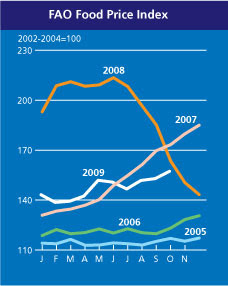
As we are barely climbing out from the worst recession since 1930, oil prices have reached mid 2007 levels already. Together with that, food prices have followed suit:

As I’ve argued in numerous previous posts, we were never out of the woods on the food / fuel pincer movement; it was the collapse in prices following the credit crunch that was the blip, not the price spike that preceded it. And what’s most frustrating now is the extent to which policymakers have frittered away the chance we had to get onto a more secure footing.
[...] Now, on top of all of that, it looks like policymakers are also in the process of fudging the one policy process that could manage oil scarcity and climate change at the same time: the Copenhagen talks on the UNFCCC post-2012 commitment period.
The problem, of course, is that once prices for oil and food rise beyond a certain level, we all go back into kneejerk / panic mode – and try talking about the need for cooperative long term frameworks then. Sigh. #Fail.

Friday, November 13, 2009

Guardian: GM crops to save Africa from disaster?

In a new scientific paper, professor Sir Gordon Conway predicts a catastrophic increase of food shortages in Africa, as a result of the devastating impact of climate change on the continent - the Guardian reported. Africa already suffers to a greater extent than the rest of the world from the effects of climate change, such as rising temperature, more droughts, floods and storm surges.
Conway predicts hunger on the continent could increase dramatically in the short term as droughts and desertification increase, and climate change affects water supplies. "Projected reductions in crop yields could be as much as 50% by 2020 and 90% by 2100," the paper says.
"In certain circumstances we will need GM crops because we wont be able to find the gene naturally. GM may be the speediest and most efficient way to increase yields. Drought tolerance is governed by a range of genes. It is a big problem for breeders of [both] GM and ordinary plants."
Sir Gordon argues that more research into climate change needs to be done. Whereas forecasts all predict increasingly extreme weather conditions, their exact manifestation remains uncertain.

Monday, October 19, 2009

ReliefWeb: The impact of the economic crisis on food security - impacts and lessons learned

Reliefweb notified the release of the 10th progress report by the UN Food and Agricultural Organisation on The State of Food Insecurity in the World 2009.
This report highlights the fact that, even before the food crisis and the economic crisis, the number of hungry people had been increasing slowly but steadily. With the onset of these crises, however, the number of hungry people in the world increased sharply.

As a result of the global economic crisis, developing countries are facing declines in remittances, export earnings, foreign direct investment and foreign aid, leading to loss of employment and income. This loss of income is compounded by food prices that are still relatively high in the local markets of many poor countries. As a result, poor households have been forced to eat fewer meals and less-nutritious food, cut back on health and education expenses, and sell their assets.

Despite the financial constraints faced by governments around the world, agricultural investment and safety nets remain key parts of an effective response to reduce food insecurity both now and in the future.

Monday, September 21, 2009

AlertNet: Bad harvest + El Niño = Hunger in the Horn of Africa

The UN Food and Agricultural Organisation (FAO) has released a new report warning for increased hunger in Eastern Africa, Reuters reported. The number of food aid-dependent people, now already some 20 million, is likely to increase following poor crop forecasts due to continued drought in the region.
The effects of El Niño, which usually brings heavy rains towards the end of the year, could make matters worse, resulting in floods and mudslides, destroying crops both in the field and in stores, increasing livestock losses and damaging infrastructure and housing.
In Kenya, Uganda and Ethiopia crops are expected to drop significantly and endanger the food security of many millions of Africans. But, worst hit is Somalia:
According to FAO's Food Security and Nutrition Analysis Unit, Somalia is facing the worst humanitarian crisis in 18 years, with approximately half the population - an estimated 3.6 million people-- in need of emergency livelihood and life-saving assistance. This includes 1.4 million rural people affected by the severe drought, about 655 000 urban poor facing high food and non-food prices, and 1.3 million internally displaced people, a result of escalating fighting and conflict.

Sunday, September 13, 2009

IRIN: A rough guide to climate change in Africa

The World Economic and Social Survey (WESS), published annually by the UN Department for Economic and Social Affairs, has devoted its 2009 issue to climate change. It includes an accessible, if unsettling, guide to some of the major impacts of climate change in various African countries, based on the IPCC's reports. Some headlines after the jump, or read more and download the full report from IRIN.

Some headlines:

Food security

East Africa

Rainfall is expected to increase in some parts of the region. The loss of about 20 percent of plant and animal life in Lake Tanganyika is projected, with a 30 percent decrease in fish yields. In Kenya a one-metre rise in the sea level could affect the production of mangoes, cashew nuts and coconuts, causing losses of almost US$500 million a year. On the plus side, in parts of the Ethiopian highlands a combination of higher temperatures and better rainfall may lengthen the growing season.

Southern Africa

More frequent El Niño conditions - in which sea surface temperatures become warmer across the central and eastern Pacific Ocean - could disrupt rains, bringing a notable drop in maize production. On the other hand, growing seasons may lengthen in parts of Southern Africa, for example Mozambique, owing to a combination of increased temperature and higher rainfall. South Africa: In Africa's major grain producer net revenues from crops could shrink by up to 90 percent by 2100.

Water resources

East and West Africa

Rainfall is likely to increase in these regions, easing droughts in the east of the continent but bringing more frequent floods in the west.

Southern Africa

Large areas of the region are already experiencing water shortages, or are arid and trying to prevent encroaching desertification, so there is likely to be a greater number of people living with water stress by 2055 as rainfall becomes more erratic or declines.

Health

West Africa

Good news! By 2050 and beyond, a large part of the western Sahel will probably become unsuitable for malaria transmission.

East Africa

Based on parasite survey data, the previously malaria-free highland areas of Ethiopia, Kenya, Rwanda and Burundi could experience modest incursions of malaria by the 2050s, with conditions for transmission becoming highly suitable by 2080s. In central Somalia, areas that now have low rates of malaria could develop high prevalence of the disease. Rift Valley fever epidemics - evident during the 1997-1998 El Niño event in East Africa and associated with flooding - could become more frequent and widespread as El Niño events increase.

Southern Africa

More areas are likely to become more suitable for malaria, with a southward expansion of the transmission zone into Zimbabwe and South Africa.

Monday, September 7, 2009

Running out of/on water?!

Several messages in the past week have highlighted the various ways in which water is becoming more and more a challenge in the lives of disaster-afflicted populations.
In Kenya, for example, the first climate change refugees have given up their herder life styles to settle down to make charcoal or sell firewood. Droughts in the country have gone up from once every decade up to almost every year. This gives nomades too little time to recover from losses suffered. In addition to the greater scarcity in drinking water, drought-induced hunger is more and more becoming a security concern in the country as well, with higher levels of violence reported.
In a similar vein, Timor Leste President Ramos-Horta warns for land-and-water wars in the near future, unless more attention will be paid to the rural areas that are more and more affected by the disastrous impacts of climate change.
On the other hand, several countries, notably in the Caribbean area, are hit by hurricanes and floods with greater intensity every year, said John Holmes, United Nations Under-Secretary-General for Humanitarian Affairs and Emergency Relief Coordinator. If no drastic reduction in carbon house emissions is negotiated at Copenhagen in December, he warns, these extreme water conditions (both the lack and abundance of it) will lead to unprecedented population movements, with high potential for conflict.
In a response to these threats, Reuters reports,
A 155-nation conference in Geneva agreed on a plan to improve climate information to help people cope with ever more droughts, floods, sandstorms and rising sea levels projected this century. The plan for a "Global Framework for Climate Services" includes the appointment of a task force of high-level, independent advisors within four months.
The panel's report is expected in twelve months, with recommendations on among others disaster risks, human health, transport and tourism, managing water, energy and securing food supplies.

Tuesday, August 18, 2009

IDS: access knowledge (no, not your own) for free!

The Institute for Development Studies celebrates the 40th birthday of its Bulletin by giving everybody free access to all their issues (for a limited period of 40 days).

Flagging up some interseting issues:

Monday, August 10, 2009

WFP: Nepal malnutrition worse than in Sub-Saharan Africa

WFP warns for severe malnutrition in Nepal that is being neglected by the international community, the Global Politician reports.
The combination of high food prices and the economic downturn has the makings of a grave humanitarian crisis in Nepal (Ranks 142 out of 177 countries in the Human Development Index in 2007) as it has been estimated that 41 of the 75 districts are food deficit. This reveals the grave nutritional statistics across Nepal – Half of children under the age of five in these districts are stunted, while 39 percent of children are underweight and 13 percent are severely malnourished according to the WFP. Meanwhile in some areas chronic malnutrition rates for children under 5 are 80 percent with acute malnutrition rates as high as 23 percent reports WFP. Unfortunately, these realities are not subjected to change in the near future as most Nepalese families survive as subsistence farmers with 24 percent of the population living on less than US$1 per day.
Key to solving this problem is the diversification of farms to increase food production, which
requires essential policy modifications to set up more effective links between food security and workable agricultural development strategies. The heart and soul of the new food security strategy should be better access of poor families to both - the farm and the food.

India Suffers Droughts, But Doesn't Want Plumpy'nut

India's Meteorological Department has released mid-monsoon season figures indicating a nationwide rain deficit of 25%, the Indian Telegraph reports. This may significantly affect the agricultural production in India, with analysts predicting a drop of 10% in production for some regions.
Drought and floods in some areas have resulted in a 25 per cent less sowing of paddy. Agriculture ministry officials are hoping that late rains would see paddy sowing going up in August.
The cause for the lack of rain is attributed to El Nino.
In the meantime, the Indian government says that it has enough stocks from previous years to compensate for the expected losses, and that it is considering a range of actions, among others to prevent food prices from soaring.

This news coincides with the Indian government's denying UNICEF to use Plumpy'nut in combating malnourishment in Bihar and Madhya Pradesh. The malnourishment is said to be worse than in Sub-Saharan Africa.
Despite the fact that WHO has accredited Plumpy'nut as ready-to-use terapeutic food (RUTF), the government does not believe in its effectiveness. Moreover, this particular kind of RUTF was not agreed upon with UNICEF. It prefers Indian alternatives, but these are still being tested and are thus not yet available.
Unicef officials said that there was no local alternative at the time and that RUTF was a medical formula, not a food, which is used to treat, rather than to prevent, malnutrition. “Children with severe acute malnutrition are at risk of imminent death and need immediate, lifesaving treatment,” Angela Walker, a Unicef spokeswoman, said. “Family foods or supplementary foods are not enough; these children need very specific treatment for their condition.” [...]
Other campaigners and experts said that a solution may lie in Indian-made RUTF, which is being produced by at least two Indian companies for export. Médecins sans Frontières, the French medical charity which treats malnutrition in Bihar and other states, said that it was testing local products and hoped to start using them by the end of the year.

Thursday, July 30, 2009

Friday, July 24, 2009

Tufts: Livelihood Impacts of Disarmament in Uganda

The latest report published by Tufts' Feinstein International Center, Changing Roles, Shifting Risks: Livelihood Impacts of Disarmament in Karamoja, Uganda by Elizabeth Stites and Darlington Akabwai, is the result of the first phase of a partnership with Save the Children in Uganda. It examines the experiences and perceptions of communities of the present disarmament campaign carried out by the Uganda People's Defence Force and the Government of Uganda.
We find that although individual experiences with disarmament have been largely negative, there is overwhelming support among local communities for an end goal of complete and uniform disarmament as a means of bringing peace and economic development. At the same time, the current policies of disarmament have brought major changes to livelihood roles and responsibilities by gender and generation, and associated shifts in exposure to risk. We examine the effects of disarmament on security, livestock management, peace processes, and food security and coping systems. Recommendations are made to international and national actors for programming, policy-making and advocacy in the areas of livelihoods and engagement with disarmament processes.

Friday, June 26, 2009

Global dashboard on the food and fuel price crisis: 'here comes trouble...'

Last year Global Dashboard wrote that
'As soon as we’re out of the downturn and demand starts going up again, we’ll discover that there’s been no shift in the underlying supply fundamentals - and hence that the stagflation drivers we were all worrying about until the credit crunch really began in earnest are just waiting where we left them.'
On the 15th June, they pointed out that oil prices have begun to recover - read more on the website.


Wednesday, May 6, 2009

HPN: Humanitarian Exchange, focus on the Food price crisis

This edition of Humanitarian Exchange focuses on the global food price crisis of 2007 and 2008. The sharp rise in food prices was mainly caused by a combination of reduced cereal stocks, increased demand and the rising price of oil, increasing the cost of fertiliser and stimulating the production of biofuels in the US. By 2008, the number of hungry people in the world had increased to over 1 billion, up from 850 million in early 2007. Populations already affected by crisis were hardest hit. While globally the price of cereals has decreased, it remains high in many of these countries.

Articles in this issue explore the extent, scale and impact of the global food crisis on vulnerable populations, particularly city-dwellers – a neglected group in humanitarian response – subsistence farmers and pastoralists.
Read the issue online at the HPN website.

Monday, April 27, 2009

Tufts: Darfur: Livelihoods, Migration and Conflict

This briefing paper discusses findings from a study conducted in Darfur from 2006-8 that explored the changing role of migration and remittances in the livelihoods of conflict-affected people. The paper highlights the livelihood changes and adaptations internally displaced people (IDPs) and their hosts have made in response to the conflict in 2003 and consequent displacement.
We think it unlikely that IDPs will return to their rural home areas and previous livelihoods, and more likely that IDPs will continue to foster their increasingly urbanized 'multi-nodal' and transnational livelihoods. This has implications for the policy environment. We argue that innovative approaches to support livelihoods are badly needed, but it is important to monitor and evaluate their impact on different groups, the local economy and environment. In particular the implications of harmful livelihood adaptations need to be recognized and addressed - 'mal-adaptive' livelihood strategies might provide food and income in the short-term, but they often incur longer-term costs for the household, and can increase societal inequities and marginalization as well as over-exploiting limited natural resources.
The report, case studies and other materials are available from the Tufts website.

Monday, March 9, 2009

BRC Global Price update (February 2009)

Here is the latest British RC update on the global price and financial crisis....

1. BRCS
- Discussions ongoing with BRC Learning & Development about funding BRC research proposal on global price & financial crisis. This research may link into research planned by UK Hunger Alliance and ODI (see below)

2. Global update
- Crisis increasingly referred to "triple F" crisis - i.e. Food, Fuel and Financial
- FAO warn that food price crisis of 2008 will continue into 2009 and may get worse

- Despite decline in international food prices in second half of 2008, prices remain high in most countries, with some countries continuing to experience very high prices...so affecting access to food of most vulnerable low income groups in these countries(FAO)
- In Southern Africa and Central America - prices of main food commodities have continued to rise or have not decreased in recent months
- In West and East Africa countries - prices have fallen significantly since start of harvest in Sept-Oct 08 but by Jan 09 they were well above their levels of a year ago. Imported rice and wheat, important staples, are still rising.
- Prices of rice and wheat still remain high in several poor countries in Asia, including Afghanistan, Pakistan and Sri Lanka

- Bumper record global harvest in 2008 means global cereal stocks at highest level since 2002.....BUT reduction in global cereal output in 2009 is predicted by FAO despite favourable climate. Areas planted declined, particularly in "low income food deficit" countries due to a reduction in expected returns and high input cost (the price of agric inputs more than doubled since 2006...poor farmers unable to afford). This means further likely hikes in food prices in 2009.

Global economic crisis may reverse recent employment gains for workers in poorest nations (ILO)

Some experts believe that financial trading in basic food commodities was the biggest factor in recent food price hikes. Global trading in futures and options in food has more than doubled in the last 5 years - with such trade increasing 30% in first 9 months of 2007

Fluctuations in US dollar has had devastating results for the poor as value of remittances fell at same time that cost of living went up, e.g. Bangladesh usually receives $4billion in remittances US annually

Other facts & figures
- There are "food crisis" in 32 countries, in addition Gaza is of particular concern (FAO)
- 18 m in the Horn and 8.7m in Southern Africa facing serious food insecurity BUT nearly 2/3rd of those living in hunger live in Asia. 65% of worlds undernourished live in India, China, DRC, Bangladesh, Indonesia, Pakistan and Ethiopia (FAO)

3. Agency & Policy activities
- High level UN meeting on Food Security for All (Madrid 26/27 Jan) - agreement on need for co-ordinated collective response to global crisis - Global Partnership for Agriculture & Food Security (GPFAFS).
- ODI planning research "High world food prices & their implications". UK Hunger Alliance may link into this research, and take recommendations and outcomes forward from an INGO perspective
- ODI & DFID supporting a network of organisations..."to inform research, advocacy, policy and action related to high and volatile food commodity prices"...IFRC a member. BRC may want to consider joining this too.- ACF published - "Feeding Hunger & insecurity: Field analysis of volatile global commodity food prices, food security & childhood malnutrition" - presented at ODI seminar in January.
- OGB - Briefing paper - "A Billion Hungry People. Governments and aid agencies must rise to challenge" released to coincide with Madrid conference
- IFPRI - Food Policy report - Food and Financial Crisis. Implications for Agriculture and the Poor - calls for reform of financial and agricultural commodity markets to reduce volatility, avoid price bubbles and respond to emergencies cause by price crisis


4. Regional/Country updates

East Africa
- High prices of key staples eased off in most areas in late Dec 2008 but prices still well above 5 year average in most countries, particularly Somalia, Ethiopia and Djibouti.
- In Kenya, significant harvest shortfall in 2008 and expected poor harvest this June/July mean that prices expected to rise in 2009 in addition, financial crisis led to 40% decline in remittances, 30% decline in stock prices and 30% decline in tourism bookings


West Africa
- generally good rains, harvest and pasture in 2008. Although food prices increasing since Jan 2008, prices generally still under the record prices reported during the 2005 crisis, although Sept prices of rice reached new records for that time of year. Livestock prices on rise and still above 5 year average (due to good market demand, favourable condition), so despite high price of grain, terms of trade (livestock for grain) still favouring pastoralists.
- Burkino Faso - despite a cereal surplus in 2008, price of maize in capital has increased 20% in Jan 2009 raising fears of rioting again. High prices due to traders from neighbouring countries buying up grain and local farmers and traders with holding cereal

Southern Africa
- Zambia - may face food crisis in 2009 as price of staples are rising due to physical shortages from lower harvest & ineffective government price controls. Also economy badly affected by large mining job losses as a result of copper prices falling by 50% over the last few months
- Malawi- food prices at historical high and may face food crisis in early 2009 due to an underestimation of 2008 harvest that led to over exportation of food and consequent current shortfall. Private traders now hoarding food.
- Swaziland - prices of essential food risen 10-40% in 2008. Food inflation 17.9%
- South Africa - tens of 1,000s facing unemployment from automotor sector as a result of reduced demand and increased costs of materials.
- Botswana - thousands of mining jobs in jeopardy as diamond and other mineral sales dwindle. Diamonds sales expected to reduce by 50%, production by 35%

Chatham House: The Feeding of the Nine Billion: Global Food Security for the 21st Century

This Chatham House Report argues that together with competition for land and higher demand resulting from increasing affluence and a growing global population represent a major challenge for global food security.This report - a longer follow-up to an April 2008 Chatham House Briefing Paper entitled Rising Food Prices: Drivers and Implications for Development - sets out to look beyond the immediate causes and impacts of the global food price crisis of recent months, towards the medium and longer term.
Download the report from Reliefweb.

Thursday, December 4, 2008

IFPRI: Helping Women Respond to the Global Food Price Crisis

The current food price crisis has received widespread attention, but discussions to date have largely overlooked the gender dimensions of the crisis. More than 15 years of rigorous research on gender and intrahousehold resource allocation suggest not only that men and women will be affected differently by the global food crisis, but also that, as both consumers and producers, they will have different stocks of resources with which to respond to rising prices. Although the current situation calls for an urgent national and international response, urgency is not an excuse for misguided policies that fail to address the gender implications of the crisis. Instead, decisionmakers should take this opportunity to incorporate what is known about women’s roles in agricultural production and household welfare, and the specific challenges they face, both to craft more effective policy responses and to enable women to respond better to the current challenges and opportunities.
Download the document from Reliefweb (pdf, 78kb).

Thursday, November 13, 2008

ALNAP: The Global Food Price Crisis: Lessons and Ideas for Relief Planners and Managers

The first half of 2008 was marked by significant rises in commodity prices, with food price increases averaging 52 percent between 2007 and 2008. While the response to the wider situation is largely outside the scope of humanitarian programmes, those managing relief and recovery efforts have faced a number of challenges. This paper lays out the background to the food price rises, outlines a number of key challenges for those planning and managing relief efforts, and suggests ideas, tools and approaches that could prove of value.

Download the paper from the ALNAP website.

Monday, November 10, 2008

Emergencies in Urban Settings: A Technical Review of Food-Based Program Options

No. 6 in FFP's Occasional Paper Series
The objective of this paper is to provide technical information and lessons learned to support the United States Agency for International Development (USAID) and its partners to effectively design and implement emergency food assistance programs in urban and peri-urban settings.

Although food assistance needs in urban and peri-urban areas are expected to require increased resources in the coming years, most experience with food-based programs is in rural areas. Against this backdrop, USAID's Office of Food for Peace Occasional Paper No. 6, Emergencies in Urban Settings: A Technical Review of Food-Based Program Options, examines 11 common food-based programs to highlight advantages, disadvantages, targeting and implementation modalities in the urban context. The paper also presents tools to help determine the most appropriate interventions and approaches for given settings.
Download the paper from Reliefweb.