What is even more important to appreciate is that the success of any disaster response effort does not fall squarely on the shoulders of humanitarian organizations. This is because humanitarian organizations do not operate in a vacuum but depend on a number of stakeholders to stage their disaster response....Read more on Roxanna's blog.
...These are the media, donors, relief item suppliers, recipient country, neighboring countries, military forces, and implementing partners. The media through coverage of a disaster often activates an emergency supply chain and is a source of information on its development. Donors provide funds, goods, services and people. Donors together with private sector suppliers provide relief items. Donors, recipient country, neighboring countries and military forces provide logistics assets. Implementing partners, that is the local and foreign NGO community, typically acts as distributors.
Tuesday, January 19, 2010
More on logistics in Haiti: Roxanna Samii

ODI: Alison Evans on long-term recovery in Haiti
As our colleagues at ALNAP have stressed in their report on lessons learned in earthquakes, it is never too soon to think about recovery. This should be part of the game plan from day one. Guided by the Haitians themselves, we now need a combined vision of what genuine recovery would look like. In addition to the obvious need for reconstruction of homes and businesses, a key priority is the rebuilding of Haitian state institutions and governance.Read more on the ODI blog.
Monday, January 18, 2010
Logistics questions around the Haiti Earthquake
A great post from an interesting blog:
A painful truth that you will not hear spelled out very often: emergency aid in these circumstances is totally dependent on local preparation, and any aid that that will come from outside the area will be largely ineffective until the logistics has been cleared up – which is usually only after several days in the most favourable circumstances. This is why disaster preparedness is so important, and it is also a main reason why countries like Haiti, which don’t have much capacity for disaster preparedness in the first place, are always so badly hit when the (inevitable) disaster strikes.Read more on A Humourless Lot, or follow Michael on Twitter.
Wednesday, January 13, 2010
ALNAP resources: urban responses and earthquakes
ALNAP has posted reminders of two of their papers which might be relevant to the response to yesterday's earthquake in Haiti:
For organisations and their staff working in Haiti or preparing to deploy there, the ALNAP Lessons Paper 'Responding to earthquakes 2008: Learning from earthquake relief and recovery operations' may prove of use. This paper aims to provide a distillation of the learning from 29 different earthquake responses taking place over thirty years of humanitarian responses. The main intended audiences are operational decision-makers and relief programme managers working in the response to such sudden-onset natural disasters. Download the paper here
As the worst affected area of Haiti appears to be the heavily populated capital city, Port-au-Prince, the ALNAP Lessons Paper'Responding to urban disasters: Learning from previous relief and recovery operations' may also be of use. Download the paper here.
Follow the thread for further resources contributed by members on the ALNAP website.
Wednesday, December 9, 2009
Global Dashboard: window of opportunity on scarcity issues starts to close
Alex Evans from the Global Dashboard has commented in a recent post on the lack of political initiatives to take preventive action regarding food (and resources in general) scarcity. The window of opportunity presented them by the credit crunch and the global downturn starts to close with rising oil prices.
As we are barely climbing out from the worst recession since 1930, oil prices have reached mid 2007 levels already. Together with that, food prices have followed suit:
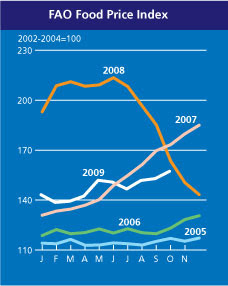
As I’ve argued in numerous previous posts, we were never out of the woods on the food / fuel pincer movement; it was the collapse in prices following the credit crunch that was the blip, not the price spike that preceded it. And what’s most frustrating now is the extent to which policymakers have frittered away the chance we had to get onto a more secure footing.[...] Now, on top of all of that, it looks like policymakers are also in the process of fudging the one policy process that could manage oil scarcity and climate change at the same time: the Copenhagen talks on the UNFCCC post-2012 commitment period.The problem, of course, is that once prices for oil and food rise beyond a certain level, we all go back into kneejerk / panic mode – and try talking about the need for cooperative long term frameworks then. Sigh. #Fail.
Maps: climate injustice and the first humanitarian map to really help aid workers
Here are a few interesting updates from the mapping department:
The Global Dashboard posted two interesting maps offering a view on the world from the perspective of climate change. They show the countries' size according to their fossil-fuel carbon-dioxide emissions and the burden they are carrying due to climate change. Note the startling contrast between 'the West' and Africa-Asia! Both maps come from a recent report of the World Population Fund (UNFPA) on women, population and climate change.


The Aid Worker Daily also posted about the release of the first interactive map that allows everybody to update its contents. This way aid workers have an excellent up to date account of the site they're working in (c.q. Kibera, Nairobi, Kenya). To be expanded soon to other (urban) areas, hopefully!
Wednesday, December 2, 2009
AlertNet: A humanitarian's guide to Copenhagen
In attendance of next week's COP 15, AlertNet published a list of humanitarian focal points for Copenhagen. Although not party to the actual negotiations, aid agencies will try to influence the negotiations with presentations on the sidelines of the conference. In so doing, they will provide the negotiators with the humanitarian story of climate change.
A few of the points discussed:
- How much money will be available to help communities adapt to an increasingly erratic climate?
- How will money be channelled to affected countries or communities?
- How do you define who is most vulnerable to climate change?
- Will forest-dwelling communities receive benefits from REDD?
- What about the rights of people displaced by increasing and more intense natural disasters?
- Will food security and agriculture get their due?
- Is anyone paying attention to protecting people's health?
Subscribe to:
Posts (Atom)


