Wednesday, December 9, 2009

Global Dashboard: window of opportunity on scarcity issues starts to close

Alex Evans from the Global Dashboard has commented in a recent post on the lack of political initiatives to take preventive action regarding food (and resources in general) scarcity. The window of opportunity presented them by the credit crunch and the global downturn starts to close with rising oil prices.
As we are barely climbing out from the worst recession since 1930, oil prices have reached mid 2007 levels already. Together with that, food prices have followed suit:
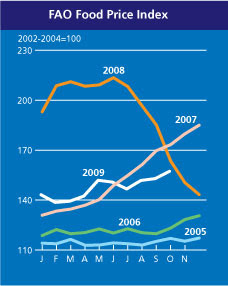
As I’ve argued in numerous previous posts, we were never out of the woods on the food / fuel pincer movement; it was the collapse in prices following the credit crunch that was the blip, not the price spike that preceded it. And what’s most frustrating now is the extent to which policymakers have frittered away the chance we had to get onto a more secure footing.
[...] Now, on top of all of that, it looks like policymakers are also in the process of fudging the one policy process that could manage oil scarcity and climate change at the same time: the Copenhagen talks on the UNFCCC post-2012 commitment period.
The problem, of course, is that once prices for oil and food rise beyond a certain level, we all go back into kneejerk / panic mode – and try talking about the need for cooperative long term frameworks then. Sigh. #Fail.

Maps: climate injustice and the first humanitarian map to really help aid workers

Here are a few interesting updates from the mapping department:

The Global Dashboard posted two interesting maps offering a view on the world from the perspective of climate change. They show the countries' size according to their fossil-fuel carbon-dioxide emissions and the burden they are carrying due to climate change. Note the startling contrast between 'the West' and Africa-Asia! Both maps come from a recent report of the World Population Fund (UNFPA) on women, population and climate change.


The Aid Worker Daily also posted about the release of the first interactive map that allows everybody to update its contents. This way aid workers have an excellent up to date account of the site they're working in (c.q. Kibera, Nairobi, Kenya). To be expanded soon to other (urban) areas, hopefully!

Wednesday, December 2, 2009

AlertNet: A humanitarian's guide to Copenhagen

In attendance of next week's COP 15, AlertNet published a list of humanitarian focal points for Copenhagen. Although not party to the actual negotiations, aid agencies will try to influence the negotiations with presentations on the sidelines of the conference. In so doing, they will provide the negotiators with the humanitarian story of climate change.

A few of the points discussed:
  • How much money will be available to help communities adapt to an increasingly erratic climate?
  • How will money be channelled to affected countries or communities?
  • How do you define who is most vulnerable to climate change?
  • Will forest-dwelling communities receive benefits from REDD?
  • What about the rights of people displaced by increasing and more intense natural disasters?
  • Will food security and agriculture get their due?
  • Is anyone paying attention to protecting people's health?

Monday, November 23, 2009

FIC + HFP Humanitarian Horizons: tackling future challenges

The Feinstein International Center (FIC) of Tufts University and the Humanitarian Futures Programme (HFP) of King's College London initiated a joint project called Humanitarian Horizons. This project, launched in October 2008, focuses both on HFP's analyses of changing dimensions of future crisis drivers and on making more practical the exploratory futures research of FIC's Ambiguity and Change project. So far four papers by leading experts have been released, which will be incorporated into a "Practitioners' Guide to the Future", to be published in December 2009.
The Humanitarian Horizons project is a futures capacity-building initiative intended to assist the humanitarian sector to prepare for the complexities of the future by enabling organizations to enhance their anticipatory and adaptive capacities. The first step in this process is the exploration of four futures-related drivers widely expected to have an impact on humanitarian crises and responses to them. These four drivers are:

Monday, November 16, 2009

Dan Smith: Tories to prevent DfID from becoming uppity teenager

After having reviewed DfID's White Paper, Dan Smith tackles the Green Paper that the Conservatives published over the summer. Smith argues that, overall, the Green Paper is conservative in the wrong way.

A few appetisers:
Under the Conservatives, DFID will remain a separate department but be better coordinated with the Foreign Office and the rest of government (pp 56-57). Some may suspect that “coordinated” is a polite term for “subordinated” but the Green Paper authors would probably insist that they are talking about a recalibrated division of labour with the Foreign Office taking a clearer policy lead. Time will tell which version is more accurate but, certainly, the Green Paper offers heart to critics concerned that DFID has become an independent fiefdom with its own foreign policy.[...]
I worry that when the Conservative team criticises what it sees as the NGO culture in DFID, it is the engagement and commitment of staff members at all levels of the organisation that they are taking issue with. And I worry that if they put pressure on engagement and commitment and the accompanying spiky attitudes, NGO-ish atmosphere and casual clothes, they risk replacing those positive qualities with a bureaucratic approach that, in the event and with greater cause, will annoy them even more.
[...] one way a Conservative government will get value for money is by focusing the UK’s international aid on fewer than the 108 countries to whom it goes now. The document rightly abstains from saying how many countries will get it, though it does commit to ending UK aid to China, and it says a Conservative government will strengthen links with Commonwealth countries, implying though not promising more aid to Commonwealth developing countries. [...]
I am intensely pleased that the Conservative Party has committed itself to continuing to expand development assistance. There is much to welcome. But it has not yet done any better than the government – in fact, it has done somewhat worse – in the essential task of shaping a new way of understanding and supporting international development.

Friday, November 13, 2009

Change.org: Climate Change and Conflict

A few weeks back there was a world wide Climate Change Blog Action Day, organised by Change.org. Here are a few links that Change.org's Humanitarian Relief blogger Michael Bear gathered together, all relating to the causal impact of climate change on conflict:
Michael notes:
[T]he issue isn't one of surviving an especially fierce rain or harsh winter, but the cumulative effects of many fierce rains and many harsh winters. Next, climate change alone won't cause conflict but, along with other factors, will contribute to and shape it. It's one variable among many others, such as cultural, economic, or demographic factors. Last, unless a society learns to adapt to sustained climate change, its wealth will decline and its social fabric will weaken with each passing year. But even if a society faces these environmental challenges, a trigger--such as an assassination, extreme natural event, or random act of group violence--is usually required to ignite violent conflict.

Guardian: GM crops to save Africa from disaster?

In a new scientific paper, professor Sir Gordon Conway predicts a catastrophic increase of food shortages in Africa, as a result of the devastating impact of climate change on the continent - the Guardian reported. Africa already suffers to a greater extent than the rest of the world from the effects of climate change, such as rising temperature, more droughts, floods and storm surges.
Conway predicts hunger on the continent could increase dramatically in the short term as droughts and desertification increase, and climate change affects water supplies. "Projected reductions in crop yields could be as much as 50% by 2020 and 90% by 2100," the paper says.
"In certain circumstances we will need GM crops because we wont be able to find the gene naturally. GM may be the speediest and most efficient way to increase yields. Drought tolerance is governed by a range of genes. It is a big problem for breeders of [both] GM and ordinary plants."
Sir Gordon argues that more research into climate change needs to be done. Whereas forecasts all predict increasingly extreme weather conditions, their exact manifestation remains uncertain.